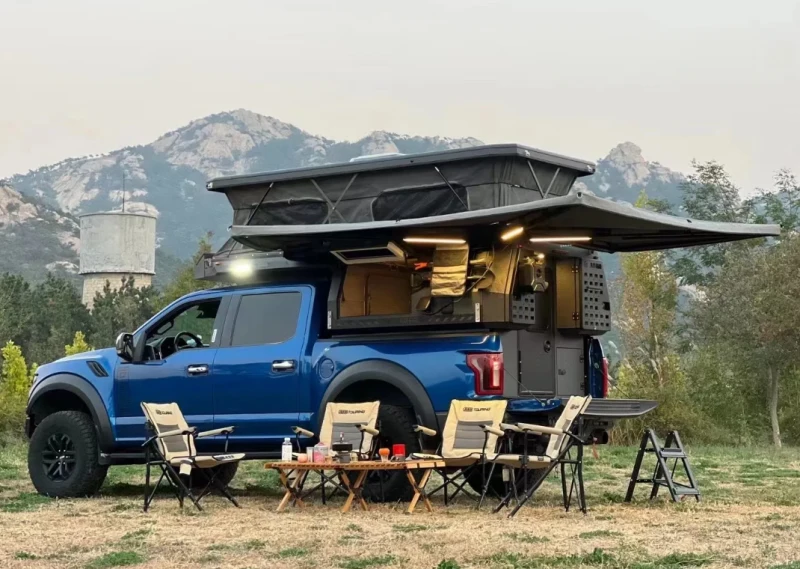
Pick-up camper camping is a style of camping that combines a pickup truck with a camper unit. You can drive your truck out of the city to forests, mountains, lakes, or remote campsites, using the camper unit mounted over the truck bed to handle essentials like sleeping, storage, and basic cooking. Unlike traditional tent camping, you don’t have to sleep directly on the ground; unlike towing a travel trailer, you don’t have to haul a separate towed RV.
If you are preparing to try pick-up camper camping for the first time, the real consideration isn’t just the camper unit itself, but whether this entire camping lifestyle suits you. Factors such as vehicle payload capacity, camper weight and layout, fresh water, battery power, solar capabilities, weather, and campsite conditions will all influence your trip experience.
This guide approaches pick-up camper camping from a practical standpoint, covering pre-trip preparations, campsite selection, camper setup upon arrival, and how long you can sustain yourself without utility hookups. It also discusses real-world scenarios—such as rain, cold weather, and off-grid camping—to help you determine if a pick-up camper is the right fit for your travel style.
What Do You Need for Pick-Up Camper Camping?
When using a pick-up camper for the first time, many people focus on the sleeping area, kitchen, and exterior aesthetics; however, the factors that truly determine the success of a trip are vehicle payload, water and power systems, and the weight of your gear.
The pick-up camper unit is just one part of the entire system. You need to view the combination of the pickup truck, camper, passengers, water, food, and camping gear as a single integrated unit, rather than calculating the camper’s weight in isolation.
A Compatible Pickup Truck
First and foremost, the pickup truck must be capable of carrying the camper.
If a camper has a “dry weight” of 2,000 lbs, you must add the weight of water, propane, batteries, food, clothing, and other gear once it is installed; the actual weight while driving could reach 2,500–3,000 lbs or more.
Therefore, you cannot rely solely on the camper’s product specifications. You must also verify your vehicle’s payload capacity, GVWR (Gross Vehicle Weight Rating), rear axle rating, and truck bed dimensions.
If you already own a pickup truck, it is recommended that you confirm its actual payload capacity before deciding on the size of the camper. For those new to truck camping, choosing a lighter camper is usually easier to manage than opting for one loaded with every possible feature.
Water, Food, and Cooking Equipment
Water requirements are easily underestimated when camping.
For a 2–3 day trip for two people, if the campsite lacks convenient potable water, you might prepare a total of 20–40 gallons; however, actual needs vary significantly based on factors like showering, cooking inside the camper, and the weather.
If you are heading to a developed campground with public restrooms and drinking water facilities, there is no need to fill your water tanks completely. Carrying tens of gallons less water means the vehicle hauls hundreds of pounds less weight.
You don’t need to overcomplicate your food and cooking gear, either. A small fridge, a portable stove, and basic cookware are usually sufficient for most short trips.
Power and Battery
Accessing electricity is much simpler if the campsite provides “shore power” (external hookups). If you plan on “boondocking” (camping off-grid), you will need to manage your own power supply.
LED lights, mobile phones, cameras, and small fridges generally don’t place a huge demand on power. For basic camping involving 1–2 people, a 100–200Ah battery system is a common starting point; however, power needs will rise rapidly if you use air conditioning, induction cooktops, or other high-wattage appliances.
Solar panels can help replenish your power during multi-day off-grid trips. A 200W–400W solar system is common for basic power needs, though the final setup should be determined by your actual daily consumption.
Choosing the Right Campsite for a Pickup Camper
A major advantage of a pickup camper is that you aren’t restricted to large RV campgrounds.
They are typically compact, and if your pickup truck has good off-road capability, you have a wider range of camping locations to choose from.
Developed Campgrounds
If this is your first time using a pickup camper, a developed campground—offering designated parking spots, restrooms, potable water, and even electrical hookups—is a more relaxed choice.
This type of environment allows you to familiarize yourself with the camper’s basic operations—such as water supply, electrical systems, kitchen use, sleeping arrangements, and ventilation—without having to deal with the complexities of off-grid camping at the same time. If your first camping trip takes you straight into a remote area lacking water, electricity, and restroom facilities, any issues with your battery or water supply could prove difficult to resolve.
Forest and Mountain Camping
A pickup camper is well-suited for forest and mountain environments.
However, you must verify road conditions before entering such areas. Gravel roads, muddy terrain, steep inclines, and narrow passages place greater demands on the pickup truck.
Off-road capability depends not just on the camper itself, but on the entire vehicle system—including tires, suspension, ground clearance, the 4WD system, and the total weight.
If you plan to frequently drive on forest roads, a lightweight camper is often easier to handle.
Off-Grid and Boondocking
The experience of boondocking differs significantly from staying at a standard campground.
Without shore power or a readily available water tap, you must manage your own water, electricity, waste, and food supplies.
This is precisely what makes pickup campers so appealing: you can bring a relatively compact living space to locations far removed from the city—provided you know your daily water and electricity consumption in advance.
How to Prepare Your Pickup Camper Before You Leave
A true camping experience often begins the day before you actually set off. If you wait until the morning of your departure to inspect the vehicle, you might easily overlook minor issues.
Check the Camper
Before leaving, inspect the camper’s doors, windows, roof, seals, jacks, tie-downs, water system, propane supply, and battery. Rubber seals and water lines deserve special attention, especially after the unit has been in storage for a long time.
If there has been heavy rain recently, check the interior for signs of dampness. A minor leak can become a major problem over the course of a multi-day camping trip.
Load the Camper
Avoid cramming everything into the camper.
Distribute heavy items—such as water, tools, and batteries—evenly to prevent overloading one side of the vehicle.
Also, keep in mind that every piece of gear adds weight that the vehicle must carry.
If you are planning a seven-day trip, consider taking a short two- or three-day test run first. You will quickly discover which items are truly essential and which ones were packed merely “just in case.”
Check Weather and Road Conditions
Weather directly impacts pickup camper camping. Check the forecast for temperature, precipitation, and wind, as well as road conditions, before you leave.
If you plan to travel into mountainous areas, check for road closures due to heavy rain, snow, or landslides. A forest road that seems easy to navigate in good weather can become treacherous after prolonged rainfall.

What Happens When You Arrive at the Campsite?
Upon arrival, there is no need to rush to unload all your gear. First, assess the parking area and decide on the best positioning for the camper.
Choose a Level Parking Spot
Try to find a relatively flat spot with good drainage. Significant slopes can make sleeping, cooking, and using the refrigerator difficult.
Also, look out for low-hanging branches, large rocks, or areas prone to pooling water. Remember, just because the pickup truck can access a spot doesn’t necessarily mean the camper can pass through safely.
Secure the Truck and Camper
After parking, ensure the vehicle is stable before leveling the camper. If you are using a pop-up camper, you can deploy the roof structure once the vehicle is secure. If your camper is equipped with an awning, don’t rush to fully extend it. Wind conditions in mountainous or open areas can change rapidly, and you may need to retract it quickly if strong winds arise.
Set Up Your Living Area
Once you start camping, you can divide your living space into two zones. The camper interior is primarily for sleeping, storage, and essential cooking, while the outdoor area can accommodate tables, chairs, and some cooking equipment.
When the weather permits, move simple cooking tasks outside; this not only reduces indoor odors but also minimizes the buildup of moisture and cooking fumes.
Living in a Pick-Up Camper During a Camping Trip
Life in a pick-up camper differs from living in a standard house. You need to learn how to organize your daily activities within a limited space.
Sleeping
The sleeping area is one of the most important parts of the camper. Beyond mattress comfort, pay attention to nighttime ventilation. Pick-up campers have compact interiors; if more than two people are staying inside, moisture from breathing can increase humidity levels.
If the outside temperature allows, crack open a window or use the roof vent to reduce condensation.
Cooking
Simple breakfasts and dinners can usually be prepared inside the camper, but outdoor cooking is often more pleasant when the weather is nice. If you cook frequently, consider setting up your stove, table, and cookware outside.
Do not use gas appliances in an enclosed space for extended periods. Ensure proper ventilation while cooking and follow the manufacturer’s safety guidelines.
Bathroom and Shower
Not all pick-up campers come with a full bathroom. Some models feature a “wet bath,” others use a portable toilet, and some rely entirely on communal campground facilities.
If you are mostly doing weekend trips, public restrooms are usually sufficient; however, if you plan on extended off-grid camping, bathroom and shower systems become significantly more important.
This is a feature to consider carefully when choosing your camper.
Camping Without Hookups: How Long Can You Stay?
Without water, electricity, or sewer hookups, the duration of your stay depends largely on your supplies of water, power, and food, as well as your waste management capacity. For two people engaging in basic off-grid camping, a 2–3 day trip is generally much easier to manage than a 7–10 day stint.
Water
If you use large amounts of water daily for showering, washing dishes, and cooking, your water supply will deplete quickly. If you conserve water and handle some cleaning tasks outside the campsite, a supply of 20–40 gallons can last significantly longer. Avoid simply filling your tanks to the max just to extend your stay, as the weight of the water itself is substantial.
Battery
Actual battery runtime depends on the equipment you use. If you primarily power LED lights, mobile phones, cameras, and a small refrigerator, a 100–200Ah setup may suffice for basic needs.
The situation changes completely if you require air conditioning, a microwave, or an electric heater. In such cases, calculating your actual daily power consumption is more important than simply aiming for a larger battery capacity.
Solar Power
Solar panels are highly beneficial for camping trips where shore power is unavailable for extended periods.
For instance, a 200W solar system can handle daily recharging for basic equipment, whereas a 400W (or larger) system is better suited for setups with higher power demands.
However, solar output is affected by weather, season, parking orientation, and shading; therefore, solar power should not be relied upon as a consistently available power source under all conditions.
What Happens When the Weather Changes?
Real-world camping is vastly different from a product showcase on a sunny day; weather changes are a crucial factor to consider when camping with a pickup camper.
Camping in the Rain
When it rains, the biggest issue is often not leakage, but moisture. Wet clothes, wet shoes, and water vapor from breathing all increase the humidity inside the camper.
Maintaining proper ventilation and dealing with wet items promptly can reduce condensation. It is also vital to choose a parking spot with good drainage; avoid parking the camper in obvious low-lying areas.
Camping in Cold Weather
Cold weather requires attention to the heater, propane supply, battery, and water lines. If nighttime temperatures are likely to drop below freezing, you must plan ahead to winterize your water system.
When using the heater, ensure that ventilation and equipment installation comply with the manufacturer’s specifications.
If you plan to camp in winter, a camper with superior insulation will be much more comfortable than a standard lightweight model.
Camping in Hot Weather
In hot weather, ventilation involves more than just opening a window. Roof vents, shading, natural airflow, and the direction in which you park all affect the interior temperature.
If your camper is equipped with air conditioning, consider your power capacity. Many off-grid camping locations lack the continuous power supply needed to run an AC unit.
Common Problems During Pickup Camper Camping
On your first camping trip, you may overlook certain factors, and encountering some issues is almost inevitable. Below is a summary of common camping problems; considering these beforehand will help ensure a perfect and enjoyable experience.
Running Out of Water
If you find yourself short on water the next morning, it usually means your water usage for the previous day was underestimated.
The solution isn’t necessarily to carry more water every time, but to track your actual consumption. After two or three trips, you will know approximately how much water you need per day.
Low Battery at Night
Running low on battery power at night is a very common issue, especially during prolonged cloudy spells when solar panels cannot generate enough charge.
You can track the power consumption of your refrigerator, lights, and other appliances before setting out, and check your battery status each evening.
Excessive Condensation
If you find heavy condensation on the windows and walls in the morning, it indicates high humidity levels inside the camper. Improving ventilation, minimizing the indoor drying of wet clothes, and using a roof vent can all help reduce moisture buildup.
Camper Is Not Level
If the camper is parked on a noticeably uneven surface, both your sleeping and living experience will be affected.
Taking a few minutes to select a suitable spot upon arrival is usually less hassle than constantly making adjustments after you’ve already parked.
Too Much Weight
If you notice the vehicle feels significantly heavier or the rear end is sagging noticeably, do not add any more gear.
Re-check the total weight—including the camper, water, batteries, food, and gear—to ensure you remain within the vehicle’s specified load limits.
Forgetting Basic Tools
Some small tools may seem insignificant at home but can prove vital in remote areas.
Items such as basic repair tools, spare fuses, a flashlight, charging cables, and simple emergency supplies are well worth keeping in your camper.
Pick-Up Camper Camping vs. Tent Camping
If you are used to tent camping, the most obvious changes when using a pick-up camper for the first time are usually improved sleeping comfort, storage space, and weather protection. Both methods are great for outdoor travel, but they cater to different camping needs.
Camping Factor | Pick-Up Camper | Tent Camping |
Sleeping Comfort | Fixed bed elevated off the ground; offers greater comfort | Usually requires a sleeping pad or air mattress; comfort depends on gear quality |
Weather Protection | Better protection against rain, wind, and cold | Protection depends on tent type and weather conditions |
Setup | Mounted on the truck; requires only unfolding and basic adjustments upon arrival | Requires pitching the tent and setting up sleeping gear |
Storage | Provides storage space in both the camper and truck | More limited; gear is typically stored inside the tent or vehicle |
Cooking | Some models include a kitchen or dedicated cooking area | Usually requires a separate stove and outdoor cooking setup |
Mobility | Drive the truck directly to the campsite | Lightweight gear, but a vehicle is still needed to transport supplies |
Off-Grid Camping | Well suited to extended stays away from developed sites; some models include water, power, and kitchen systems | Possible, but requires more self-contained equipment and supplies |
Initial Cost | Generally higher; requires a camper and a suitable pickup truck | Lower; a basic tent and camping gear are enough to get started |
Best For | Road trips, weekend camping, off-grid camping, and remote travel | Hiking, backpacking, lightweight travel, and short camping trips |
If you only camp occasionally at nearby sites and prioritize portability and a lower initial investment, tent camping remains a very practical choice. A tent, a sleeping bag, and basic cooking gear are all you need to embark on a simple outdoor trip.
If you prefer a dedicated sleeping space—avoiding the need to pitch a tent every time you arrive at a campsite—and want a more stable living environment during rain, wind, or cold weather, a pick-up camper is a more suitable option.
This is especially true if you already own a pickup truck with sufficient payload capacity, as the camper allows you to utilize your existing vehicle for travel. Products like the INNature Pick-Up Camper offer a solution that integrates sleeping, storage, and basic camping functions directly onto the truck.
Ultimately, there is no single “better” choice. Tent camping emphasizes portability and freedom, whereas a pick-up camper prioritizes comfort, convenience, and vehicle mobility.
Tips for Beginners: Camping with a Pickup Camper
For your first outing, it is not advisable to immediately attempt a complex, 7–10 day off-grid trip. Instead, choose a campground with basic amenities located close to the city for a short 1–2 night trip; this makes it easier to identify any issues.
After returning from your first trip, you can review the experience: What items went unused? How much water and battery power did you consume? Was the kitchen setup adequate? Was the bed comfortable? Was the storage layout practical?
Before setting out a second time, leave behind what you didn’t need and add the gear you truly lacked.
This approach is far more effective than trying to cram everything you *might* use into the camper right from the start.
Additionally, always have a backup plan. If you are heading to remote areas, knowing the locations of the nearest gas stations, water refill points, towns, and alternative routes in advance will make the journey much more relaxed.
Is Pickup Camper Camping Right for You?
If you enjoy road trips, weekend camping, and spending time in forests or mountains—but want to avoid the total exposure to the elements associated with tent camping—a pickup camper is a great option to consider.
It is particularly well-suited for solo travelers or couples. You get a dedicated sleeping area and the ability to do some light cooking inside the camper, plus the flexibility to drive your pickup truck into places that are inaccessible to large RVs.
However, if you frequently travel with your family or require a large kitchen, a separate bathroom, and extensive storage space, a travel trailer or motorhome might offer greater comfort.
The final decision depends not just on the camper itself, but on whether the pickup truck’s payload capacity, the camper’s layout, the number of travelers, the camping locations, and your utility needs (water and power) all align.
Conclusion
The appeal of pickup camper camping isn’t about moving an entire house onto your truck; it’s about having a mobile living space that travels wherever your vehicle goes.
You can leave the city on a Friday afternoon and reach the forest, mountains, or a lakeside spot within a few hours. Once you park, level the vehicle, and set up the camper, you have a compact space ready for sleeping, cooking, and relaxing. If conditions allow, you can even venture into more remote areas without relying on large RV campgrounds.
Ultimately, a comfortable camping experience depends less on the sheer amount of equipment in the camper and more on how well the truck’s capacity, the camper’s layout, and your water, power, and location choices work together.
If you are new to pickup campers, start with short camping trips of one or two nights to track your water, electricity, and gear needs before gradually attempting longer off-grid excursions. Once you truly understand your camping habits, the right size and configuration for your camper will become much clearer.