If you are planning to install a truck bed camper, the first thing to verify isn’t which model looks the best, but whether it actually fits your pickup.
Many people focus on the camper’s sleeping area, kitchen, bathroom, and exterior styling while overlooking critical factors like bed length, interior width, wheel well placement, cab clearance, and vehicle payload capacity. In reality, choosing a truck bed camper is a matter of matching the camper to the vehicle: dimensions must be compatible, weight must stay within the vehicle’s load limits, and the center of gravity and mounting method must meet specific requirements.
For those planning to purchase an INNature truck bed camper, it is far more prudent to first clarify your pickup’s dimensions and usage needs before selecting a model like the Basalt, Ilmenite, or a custom solution, rather than making a decision based solely on appearance.
What Is a Truck Bed Camper? Why Are Bed Dimensions So Important?
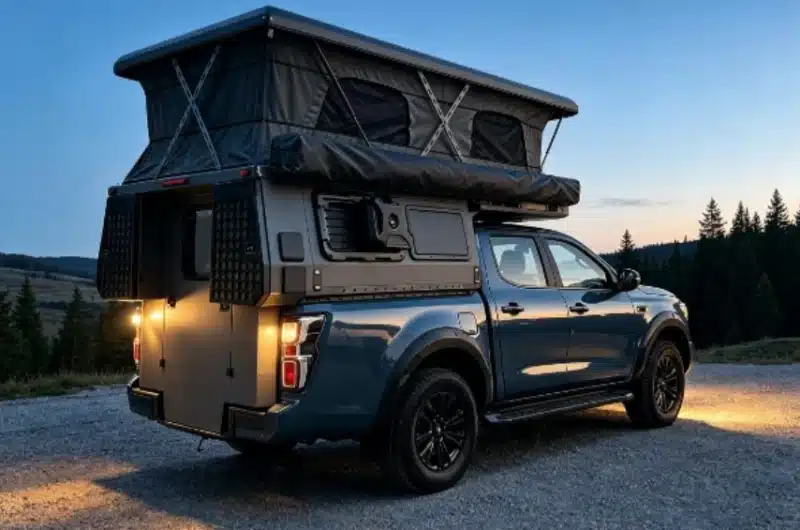
A truck bed camper is a standalone camping unit mounted onto a pickup truck’s bed, transforming the vehicle into a compact, mobile living space. Depending on the design, it can feature a sleeping area, kitchen, bathroom, shower, and storage space, as well as off-grid amenities like solar panels and battery systems.
However, there is a key difference between this and a towable RV: the pickup itself bears the full weight and dimensions of the camper.
This means you cannot simply ask, “Will this camper fit in the bed?” You must verify that the camper’s base dimensions match the bed, check for potential interference with wheel wells, ensure adequate clearance between the cab and the camper, consider the impact on the tailgate and mounting systems, and confirm that the vehicle has sufficient remaining payload capacity.
Professional truck camper fitment guides typically use bed length, bed width, wheel well spacing, cab clearance, rear overhang, center of gravity, and mounting points as key parameters. Dimensions can vary between model years, trim levels, and even different bed configurations for the same vehicle model; therefore, taking actual measurements is more reliable than relying solely on the vehicle model name.
What Measurements Should You Take Before Choosing a Truck Bed Camper?
If you already own a pickup, the simplest approach is to obtain its actual measurements.
Bed length and width
The most important measurement is the interior length of the bed. You generally need to measure from the inside front wall of the truck bed to the tailgate, noting whether the tailgate is open or closed during the measurement. Do not simply place an order based on a vehicle’s “5.5 ft bed” or “6.5 ft bed” designation, as actual dimensions can vary by a few inches depending on the specific model and configuration.
Next is the interior bed width. You shouldn’t just look at the maximum width at the top rails; you also need to verify where the bottom of the camper will actually sit. If there are wheel wells inside the bed, you must measure the narrowest width between them.
Bed Height and Cab Clearance
Height is another important factor. For campers with an over-cab sleeping area, check the clearance between the camper and the truck’s cab roof. If your pickup is equipped with roof racks, lights, or other aftermarket accessories, consider potential interference in advance.
Tailgate and Mounting Space
Finally, confirm how the tailgate is handled. Some campers can be installed with the tailgate closed, while others allow the camper to extend beyond the bed, requiring the tailgate to be left down during installation. This doesn’t necessarily indicate a size mismatch; rather, it reflects the varying structural designs of different campers.
What Is the Difference Between Short Bed, Standard Bed, and Long Bed?
Pickup truck beds on the market can be broadly categorized into Short Bed, Standard Bed, and Long Bed.
Short Beds are typically found on mid-size pickups and some full-size models, usually measuring around 5–5.5 feet in length; Standard Beds generally measure about 6–6.5 feet; and Long Beds are usually close to 8 feet. Actual dimensions vary by brand and model, so these figures serve better as general categories rather than strict purchasing standards.
For you, the key isn’t deciding “Do I want a Short Bed camper or a Long Bed camper?” right away; instead, first determine exactly which type of bed your pickup has and what its actual dimensions are.
For instance, mid-size pickups like the Toyota Tacoma or Ford Ranger are usually better suited for lightweight, compact campers. Full-size pickups like the Ford F-150, Toyota Tundra, or Chevrolet Silverado 1500 can accommodate larger campers, though the final choice should still be based on the specific model, bed length, and payload capacity. Fitment guides from various manufacturers typically match campers to specific vehicle models, model years, and bed lengths, rather than simply categorizing them by pickup truck brand.
How Do You Choose the Right Camper Size Based on Your Needs?
Bed dimensions serve as only the initial screening criterion.
If you primarily camp on weekends but also use your truck for daily commuting, a lightweight, compact camper is often the better choice. It won’t consume excessive payload capacity and allows the truck to retain its original driving agility.
If you are planning a long-distance trip for two—lasting anywhere from a few days to several weeks—interior space becomes a higher priority. You might require a proper bed, a kitchen, a refrigerator, storage space, and perhaps even a bathroom and shower. In this scenario, rather than focusing solely on whether the unit “fits,” it is better to consider the overall balance between bed dimensions, vehicle payload capacity, and camper functionality.
The situation differs if your travel style leans toward overlanding or off-roading. Your vehicle will frequently encounter rough terrain, steep inclines, and narrow paths; the heavier the camper, the higher its center of gravity, and the longer its rear overhang, the more significantly it will impact vehicle handling and off-road capability.
This is precisely why the “largest size” is not necessarily the “best choice.”
Why Is a Lightweight Truck Bed Camper More Important for Your Pickup?
When choosing a truck bed camper, weight is often more critical than external dimensions.
Don’t just look at the camper’s dry weight.
The “dry weight” you see refers only to the weight of the unit itself. Once you hit the road, you must factor in the weight of passengers, fresh water, batteries, propane, food, luggage, camping gear, and optional equipment. INNature’s buying guides emphasize that when determining if a pickup is suitable for a camper, you should consider the actual loaded weight rather than just the camper’s unloaded weight.
A lightweight design is particularly valuable for users with mid-size or half-ton pickups.
INNature’s Black Stone Basalt Pickup Camper features a composite sandwich panel structure with a dry weight of approximately 500–600 kg and dimensions of roughly 2890 × 2000 × 2100 mm, integrating a kitchen, queen-size bed, bathroom, and shower into a compact space.
The significance of this design goes beyond simply being “lighter.” Controlling the camper’s weight allows you to reserve more payload capacity for passengers, gear, water, and other outdoor equipment, while also making it easier to maintain the pickup’s handling characteristics.
How does a lightweight design affect your driving experience?
If you frequently drive on mountain roads, sand, or unpaved terrain, a low center of gravity and balanced weight distribution are crucial. INNature’s off-road camper designs factor the placement of water tanks, batteries, and storage compartments into center-of-gravity management, rather than simply cramming all equipment inside the unit.
How Should You Match a Truck Bed Camper to Your Vehicle Model?
Once you have decided to purchase a camper, the next step is to consider your vehicle model and truck bed size together.
For instance, mid-size pickups include models such as the Toyota Tacoma, Ford Ranger, Chevrolet Colorado, GMC Canyon, and Jeep Gladiator. These vehicles generally have smaller dimensions and lower payload capacities than full-size pickups, making them better suited for lightweight, compact campers. Full-size pickup trucks—such as the Ford F-150, F-250/F-350, Toyota Tundra, Ram 1500/2500/3500, and Chevrolet Silverado—offer larger cargo beds and greater payload capacity. Pickup trucks across different classes vary significantly in the weight of the camper they can handle; therefore, suitability cannot be determined by brand alone.
INNature’s product lineup covers a wide range of models, including the Ford Ranger, Toyota Hilux, Isuzu D-MAX, Nissan Navara, Mitsubishi L200, GMC Sierra, and Ford F-150/F-250/F-350. For vehicles not on the list, INNature also offers consultation regarding model compatibility.
Here is a practical approach:
Determine your vehicle model and cargo bed dimensions first, then select the camper to match, rather than choosing a camper first and trying to force it to fit your truck.
If you have a unique vehicle, or if your cargo bed dimensions and tailgate structure differ from standard models, it is best to provide the manufacturer with the model year, bed length, internal dimensions, and payload capacity before purchasing so they can confirm the compatibility plan.
Can a Truck Bed Camper Be Customized If Standard Sizes Don’t Fit?
Yes; for truck bed campers, customization goes far beyond just changing colors or interior finishes.
Customization is more than just changing the appearance
True customization adds value through adjustments to dimensions, layout, weight, and vehicle compatibility.
For example, you might own a pickup with a 5.5-foot short bed but desire a more complete sleeping and kitchen area; or, if you drive a non-mainstream model, a standard camper’s base dimensions might not perfectly match your cargo bed. In such cases, adjustments can be made to the camper’s external dimensions, base structure, interior layout, and equipment configuration.
INNature supports customization, allowing for changes to appearance and color as well as configuration designs tailored to specific project needs. Their “Ilmenite” Pop-Up Pickup Camper lists various compatible models but explicitly recommends confirming compatibility in advance for other vehicle types.
Why might different pickup trucks require different sizes?
It is important to note that customization isn’t simply about making the camper longer or wider. Changing the camper’s dimensions can alter its weight, center of gravity, interior space, mounting points, and the load placed on the vehicle. This highlights the value of manufacturer involvement in the design process: a truly sound customization plan should start with “what your pickup can carry,” rather than simply “how large a living space you want.”
How Do You Tell If a Camper Is the Right Size but the Wrong Weight?
This is a detail easily overlooked during the buying process.
Even if the camper fits your truck bed perfectly in terms of length, the setup may still be problematic if the combined weight—including water, batteries, gear, and passengers—approaches or exceeds the vehicle’s payload capacity.
You can find your vehicle’s specific payload capacity on the “Tire and Loading Information” label near the driver’s side door, then estimate the camper’s actual weight when road-ready. Professional fitment tools also use payload, center of gravity, and mounting points as key parameters to determine compatibility.
A crucial point to remember here is:Camper Dry Weight ≠ Actual Operational Weight.
If you are planning a long-term trip, you should factor in water, batteries, propane, personal belongings, and gear to determine if you have sufficient remaining payload capacity.
This is particularly relevant for lightweight campers. You don’t need to haul excessive weight just to gain a little extra interior space; the use of composite materials, compact layouts, and smart equipment choices allows for a better balance between comfort and the vehicle’s load-bearing capacity.
Short-Bed vs. Long-Bed Camper: Which Is Right for You?
If you prioritize city driving, off-road capability, and vehicle maneuverability, a short-bed camper is often the better choice. Its compact size makes the overall vehicle length easier to manage.
If living comfort is your priority—and you want a larger bed, kitchen, storage space, or even a separate bathroom—a longer truck bed offers more room for the camper’s design.
However, there is no need to simply conclude that “long-bed is better than short-bed.”
For someone who primarily goes weekend camping, a lightweight camper might be more practical than a large hard-sided model; for those preparing for long-term travel or off-grid living, greater interior space and comprehensive amenities may be more important.
The truly ideal truck bed camper is one that aligns with both your vehicle and your lifestyle.
What Information Should You Check Before Buying a Truck Bed Camper?
When requesting a quote from a manufacturer, it is best to avoid sending a message as simple as:
“I need a truck camper for my Ford F-150.”
A more effective inquiry should include your vehicle model, year, bed length, internal bed width, distance between wheel wells, payload capacity, and the features you wish to retain or add.
At the same time, confirm the camper’s external dimensions, base dimensions, dry weight, estimated loaded weight, center of gravity, and mounting method with the manufacturer.
If you choose INNature, you can discuss various options tailored to your specific vehicle and usage needs. For instance, if you prioritize off-roading and lightweight design, you might focus on lightweight models like the Black Stone Basalt; if you want to maximize functionality within a compact space, you could consider configurations that include a pop-top roof, kitchen, bathroom, and other amenities.
The decision-making process can be broken down into a simple sequence:
Measure your pickup → Confirm vehicle compatibility → Check bed dimensions → Verify camper dimensions → Calculate actual weight → Check center of gravity and mounting method → Decide on interior configuration.
A camper selected this way won’t just “fit” onto your truck; it will be truly compatible with your vehicle and perfectly suited to your travel style.
Truck Bed Camper Size Selection FAQ
1.Does the truck bed camper have to match the truck bed length exactly?
Not necessarily. The camper does not need to match the bed length exactly, but you must ensure that the camper’s base dimensions, rear overhang, mounting method, and cab clearance meet the vehicle’s requirements. Compatibility should ultimately be verified based on the specific pickup model, year, and actual bed dimensions.
2.Can a 5.5-foot pickup accommodate a truck bed camper?
Yes, but you need to select a camper designed for a “short bed” and verify both the bed dimensions and the vehicle’s payload capacity. “5.5 ft” is merely a bed length category; actual compatibility depends on the specific vehicle model, camper dimensions, weight, and mounting method.
3.What specifications should be checked before installing a truck bed camper?
Key factors to check include bed length, internal width, distance between wheel wells, bed height, cab clearance, payload capacity, camper weight, center of gravity, and mounting method. These parameters must be considered holistically; you cannot determine suitability based on bed length alone.
4.How do I determine if an INNature truck bed camper is suitable for my pickup?
You can provide details such as the pickup’s make, model, year, bed length, key dimensions, and payload capacity, along with your intended use (e.g., short camping trips, long-distance travel, or overlanding). INNature can then recommend the appropriate camper size, structure, and configuration based on these vehicle specifications and your needs.