Remote work is transforming how people work, sparking growing interest in “van builds.” A well-planned van can do more than just facilitate travel; it can serve as a mobile office that seamlessly integrates work, living, and exploration. For those engaged in long-term remote work, balancing productivity with comfort within a limited footprint has become the most critical aspect of the van conversion process.
Whether you plan to tackle a DIY build or opt for an efficient modular solution, creating a van truly suited for remote work requires careful planning regarding spatial layout, the work environment, connectivity and power systems, and future needs. Only a design tailored to your specific workflow can transform a van into a stable, highly efficient mobile workspace.
Drawing on the latest trends for 2026, this article explores the core design principles of remote work van builds, common layout options, and the differences between DIY and modular conversions, helping you discover flexible, high-efficiency mobile office solutions.
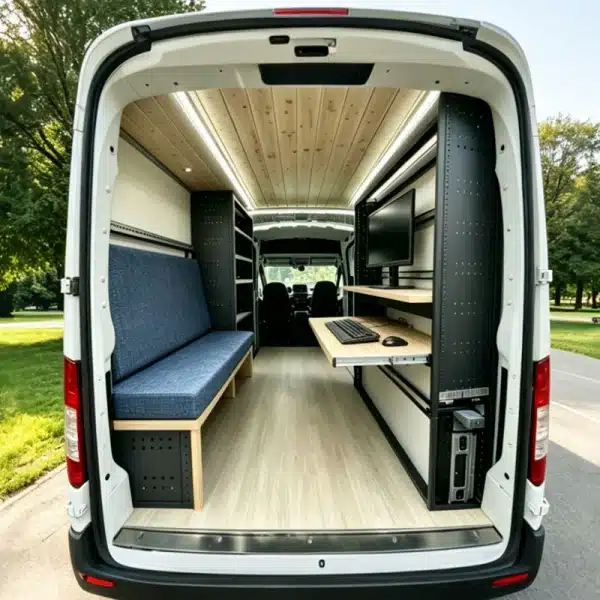
Why Are More People Choosing Remote Work Vans in 2026?
If the van build trend of 2026 could be summed up in one sentence, it would be: “The workspace is going mobile.”
Statistics from remote work organizations and digital nomad communities over the past few years show a continued rise in the global remote workforce. More companies are embracing hybrid work models, while advancements in high-speed internet, cloud collaboration tools, and AI-powered office software mean work is no longer confined to traditional office buildings.
This shift has transformed the van from a mere travel vehicle into a genuine workspace.
For many, the primary appeal isn’t necessarily living on the road full-time, but rather the freedom to switch lifestyles at will. One day, you might park by a lake to handle a full schedule of video conferences; the next, you could finalize a design project beside a forest; and on weekends, you can head straight out on a camping trip without the hassle of repacking your gear.
At the same time, the demand for mobile office capabilities is becoming increasingly apparent across various professions.
Photographers can organize assets and complete post-production work on the go; YouTubers can edit videos while traveling; structural engineers can bring their project office directly to the construction site; cross-border e-commerce operators can work freely between cities; and even startup teams are beginning to use vans as temporary meeting rooms and showcase spaces. It is not merely the allure of freedom that drives this trend, but the promise of efficiency.
Compared to traditional office setups, a well-designed “remote work van” cuts down on commuting time, offers greater autonomy over one’s work environment, and allows for more flexible boundaries between work and personal life. This is why more people are rethinking the concept of a van build: it is no longer just a vehicle, but a comprehensive mobile office solution.
What Kind of Van Build Is Truly Suited for Remote Work?
If your van serves as both a travel vehicle and a daily workspace, your design approach needs to shift. Unlike traditional camper vans that prioritize sleeping and living areas, a van designed for remote work must balance productivity, comfort, and flexible space utilization—enabling you to maintain a steady, efficient workflow whether you are in the city or the great outdoors.
Ergonomic workspaces boost productivity
Working inside a vehicle for extended periods places higher demands on spatial design. Factors such as desk height, seat support, and monitor placement directly impact your daily work experience; a comfortable workspace helps you maintain a higher level of focus.
Prioritizing an ergonomic work area—rather than sinking your budget into extra lifestyle amenities—often yields a better long-term experience. It reduces strain on your shoulders, neck, and lower back, making mobile work feel more natural and effortless.
Reliable internet and power systems are essential
Remote work relies heavily on stable internet connectivity and a continuous power supply. Today, technologies like 5G, Starlink satellite internet, and high-performance lithium battery systems have become standard features in many remote work vans, liberating you from location constraints.
Whether you are handling video conferences and cloud-based collaboration or powering computers, photography gear, and mobile devices, a robust network and energy system ensures workflow continuity and minimizes disruptions caused by equipment or signal issues.
A comfortable work environment is equally important
Your work experience is shaped not only by your equipment but also by the interior environment. Ample natural light, well-planned artificial lighting, good ventilation, and stable temperatures make long hours of work much more comfortable.
Additionally, a tidy, organized layout and effective sound insulation help minimize external distractions, allowing you to stay focused and productive across various environments.
Flexible layouts adapt to diverse use cases
For those working remotely over the long term, the van serves as both an office and a living space. The space requires sufficient flexibility to allow for focused work during the day, followed by a quick transition to modes for resting, dining, or camping once the workday ends.
In recent years, modular design has emerged as a key trend in van builds. Unlike fixed layouts, modular designs allow for flexible adjustments to functional zones based on the situation, balancing work, daily living, and travel within a limited footprint while offering greater potential for future upgrades and modifications.
Which Van Layout Is Best for Remote Work?
There is no single “perfect” van layout; the ideal solution depends on your work style, frequency of use, and daily needs. Some people require a desk suitable for an eight-hour workday, while others prioritize storage capacity or a dedicated rest area. Therefore, when planning your build, rather than chasing complex designs, it is better to first clarify your specific use cases and then design the layout around your core requirements.
Layout for Solo Remote Work
For a van primarily used by one person, an open-plan layout is usually the most efficient choice. Keeping the desk, rest area, and storage space appropriately separated not only reduces the feeling of confinement but also facilitates quick transitions between work and leisure.
For professions such as software development, graphic design, or copywriting, a suitably sized desk paired with ample natural light meets the vast majority of work needs. Preserving enough open space for movement also makes spending long periods inside the van more comfortable.
Layout for Two-Person Work and Travel
When two people work remotely simultaneously, the layout focus shifts from maximizing space efficiency to ensuring mutual non-interference.
Many two-person van builds utilize face-to-face or L-shaped desk arrangements to provide each person with a relatively independent workspace. Additionally, incorporating storage cabinets, multi-functional dining tables, and foldable furniture allows the limited space to accommodate various needs—including working, dining, and resting.
For couples traveling long-term, content creation teams, or entrepreneurial partners, this type of layout balances work productivity with the quality of the travel experience.
Layouts for Content Creators and Mobile Work Teams
Photographers, video creators, and mobile work teams often need to carry more equipment, requiring a different approach to layout design.
Beyond the standard workspace, the design must incorporate storage for cameras, drones, lighting equipment, and portable power stations, while ensuring that charging areas and workspaces do not interfere with one another. Proper equipment management not only boosts work efficiency but also prevents equipment damage while the vehicle is in motion.
As more creators begin working while traveling, this type of layout—balancing creative work with office tasks—has emerged as a key trend in van builds for 2026.
DIY Van Build or Modular Van Build?
In the past, most van builds were DIY projects. Every stage—from insulation and utility systems to furniture fabrication—required a significant investment of time and effort. While DIY offers greater creative freedom for hands-on enthusiasts, it also entails longer build times, higher costs associated with trial and error, and the burden of future maintenance.
In recent years, as modular van conversion solutions have matured, more people are reconsidering the necessity of building an entire project from scratch.
For those who want to hit the road sooner, modular designs eliminate complex design, fabrication, and installation processes. They maintain high space efficiency while simplifying future upgrades and maintenance.
The comparison below offers a clear overview of the differences between the two approaches.
Comparison Item | DIY Van Build | Modular Van Build |
Installation Time | Typically takes weeks to several months, depending on experience and project complexity. | Usually completed within a few days, allowing you to get on the road much faster. |
Conversion Difficulty | Requires woodworking, electrical, plumbing, and other specialized skills. | Designed for easy installation with minimal technical expertise. |
Flexibility & Space Adjustment | Layout changes after completion are often difficult and expensive. | Modular components can be reconfigured or expanded as your travel needs change. |
Maintenance & Repairs | Repairs often require custom fabrication or self-troubleshooting. | Individual modules can be removed, replaced, or upgraded with less effort. |
Overall Cost | Initial budget may increase due to mistakes, redesigns, and additional materials. | Costs are more predictable, making it easier to stay within budget. |
Neither approach is inherently superior to the other. If you enjoy the hands-on conversion process and have plenty of time, DIY remains a fun and rewarding choice. However, if you prefer to focus your time on work, travel, or entrepreneurship, a modular solution can help you get up and running much faster.
Why Are More People Choosing Modular Mobile Offices?
As remote work becomes a long-term norm, the demands for van builds have shifted. In the past, the focus was often on accommodation needs; today, the emphasis is on work efficiency, spatial flexibility, and the ability to upgrade later.
This shift drives the rapid growth of modular design.
Unlike fixed furniture, modular systems allow the layout to be adjusted freely based on the situation. For instance, you can have a dedicated workspace during the day and quickly convert the area into a relaxation or camping zone after work, without having to completely reorganize the vehicle’s interior.
For long-term van users, this flexibility not only maximizes space utilization but also adapts to evolving work requirements.

How Does INNature VanBox Create a True Mobile Office?
As a modular system designed specifically for vans, the INNature VanBox focuses on helping you balance work, daily living, and travel needs within a limited space—going far beyond simply adding furniture.
The VanBox employs a modular design philosophy, allowing functional units—such as desks, storage cabinets, sleeping areas, and equipment mounts—to be configured according to vehicle dimensions and specific usage requirements. This enables a logical spatial layout that keeps the interior tidy and organized.
For those engaged in long-term remote work, this design provides a stable workspace while eliminating the layout-tweaking hassles often associated with traditional DIY conversions. Should your work needs change, you can simply add or swap out specific modules rather than overhauling the entire vehicle.
Beyond flexible spatial planning, the VanBox prioritizes installation efficiency and ease of maintenance. Compared to complex, ground-up conversions, this modular approach significantly shortens installation time and simplifies future upgrades, allowing the vehicle to be put into service much sooner.
Whether you are a digital nomad, content creator, engineering team, or an entrepreneur looking to create a mobile office, a well-planned modular system transforms your van into a highly efficient space that seamlessly integrates work and life—which is precisely why so many people are opting for modular van builds.
What Is the Budget for Building a Remote Work Van in 2026?
There is no standard price for a van build, as the budget depends on factors such as the vehicle model, the extent of the conversion, equipment specifications, and intended use. Costs vary significantly depending on whether you are building a van for light work and weekend getaways or creating a mobile office suitable for long-term living and working.
Below is a common budget reference to help you plan your overall investment.
Item | Estimated Budget (USD) | What’s Included |
Used or New Van | $25,000–$70,000 | Cargo van or passenger van, depending on brand, model, age, and condition. |
Insulation, Soundproofing & Basic Fit-Out | $3,000–$8,000 | Thermal insulation, wall and ceiling panels, flooring, ventilation, and interior finishing. |
Electrical System | $4,000–$10,000 | Lithium battery bank, inverter, solar panels, charge controller, wiring, and electrical distribution. |
Network & Communication Equipment | $500–$2,000 | Mobile hotspot, Starlink or cellular internet equipment, Wi-Fi router, signal booster, and accessories. |
Office Furniture & Interior Modules | $3,000–$15,000 | Modular desk, seating, storage cabinets, workstation components, and workspace accessories. |
Living Amenities & Storage Systems | $2,000–$8,000 | Bed platform, kitchenette, refrigerator, water system, storage cabinets, and everyday living essentials. |
For DIY projects, the initial budget may appear lower; however, rework, material waste, and tool purchases often drive up the total cost during construction. A lack of conversion experience can also lead to issues with wiring, plumbing, or structural design, resulting in higher long-term maintenance costs.
In contrast, while established modular solutions involve a clearer upfront investment, they shorten the installation timeline and minimize extra expenses associated with later adjustments. For those looking to get up and running quickly, this approach generally makes it easier to control the overall budget and saves a significant amount of time.
FAQ about Remote Work Van
Is a van really suitable for long-term remote work?
With a stable internet connection, a reliable electrical system, and a well-planned workspace, a van can fully meet the needs of long-term remote work. Today, an increasing number of digital nomads, freelancers, and startup teams use vans as their primary workspace while maintaining productivity levels comparable to a traditional office.
Can a single van meet both work and living needs?
Yes, provided the space is planned effectively. Through the use of foldable furniture, modular storage systems, and flexible functional zones, a van can seamlessly transition between working, resting, dining, and traveling, maximizing the value of the limited space available.
How should I choose between a DIY conversion and a modular solution?
If you have extensive conversion experience and are willing to invest significant time in design and construction, DIY offers greater freedom for personalization. If you prefer a quick setup with less construction complexity and reduced maintenance stress, a modular solution is usually more time-efficient, hassle-free, and better suited for long-term use.
Can a modular van build be upgraded later?
Yes, that is a major advantage of modular design. As work requirements evolve, specific functional modules can be added, adjusted, or swapped based on actual needs without dismantling the entire interior layout, offering superior flexibility and long-term utility.
Conclusion
Whether you plan to build from scratch or prefer a modular approach to shorten the conversion timeline, the first step is to plan based on your specific work style, usage scenarios, and future needs. A well-tailored van build not only boosts daily productivity but also fosters a more natural balance between travel, lifestyle, and work, opening up endless possibilities for every journey.
If you are planning a van for remote work and want to avoid complex design and installation processes while securing a flexible, efficient spatial solution, INNature VanBox offers a professional modular mobile office system. From layout design and vehicle compatibility to custom functional modules, we provide personalized recommendations tailored to your needs, helping you create your own mobile office more quickly.
Contact the INNature team to receive VanBox product details, vehicle compatibility options, and expert one-on-one advice, and let’s build a remote-work van designed for the future of work.