When selecting a suitable Apple Cabin manufacturer, you shouldn’t rely solely on product photos and price quotes. This is especially true if you intend to use the Apple Cabin for glamping sites, resorts, hotels, vacation homes, or other commercial projects; you need to evaluate the manufacturer’s actual production capabilities, product quality, customization options, capacity for bulk delivery, and experience with overseas projects.
For B2B projects, choosing a manufacturer is really about assessing their comprehensive supply capabilities. You need to know if the company manufactures the Apple Cabins in-house, the extent of customization available, the structural design and materials used, whether they have robust quality control processes, and if they have a track record of similar overseas projects. Only by comparing this information can you determine if a manufacturer is truly the right fit for your project.
The most effective approach is to first define your project requirements and then evaluate different manufacturers against a consistent set of criteria. Factors such as factory strength, structural design, customization capabilities, production capacity, quality control, export experience, technical documentation, and project support should all be part of your assessment.
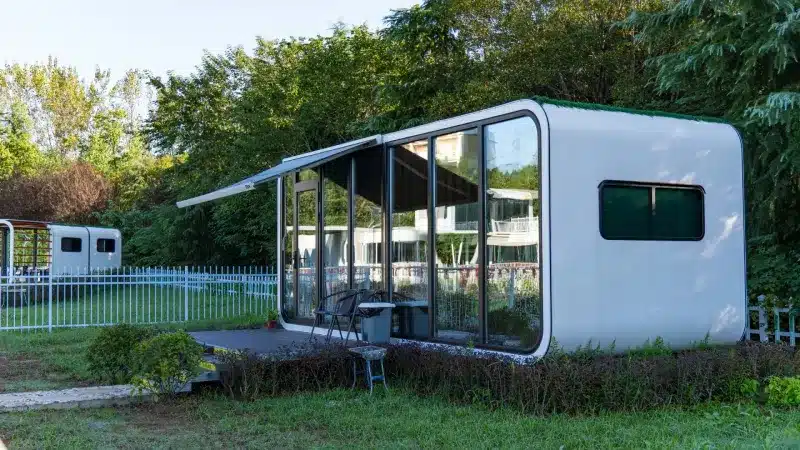
What Should You Look for in an Apple Cabin Manufacturer?
When selecting an Apple Cabin manufacturer, try looking beyond the price quote.
What really matters is whether the factory can consistently translate your project requirements into the final product. While Apple Cabins may appear simple in structure, factors such as dimensions, glazing area, wall insulation, bathroom layout, electrical systems, and interior finishes all significantly impact the final user experience. Product specifications vary widely among suppliers; the market offers everything from basic cabin shells to fully finished units complete with bedrooms, bathrooms, kitchens, and furniture.
A beautiful product photo alone makes it difficult to gauge a manufacturer’s true production capabilities. It is far more important to look for evidence such as actual factory photos, details on the production process, material specifications, technical drawings, photos of container loading, and case studies of completed projects.
For B2B projects, manufacturing capabilities, customization options, quality control, mass production capacity, and export experience are often far more critical than the product images displayed on a website.
Is the Apple Cabin Manufacturer a Factory or a Trading Company?
This is a step easily overlooked when screening suppliers.
Many companies use terms like “manufacturer,” “factory direct,” or “China apple cabin supplier,” but what you really need to verify is where the core components—such as the main structure, walls, doors, windows, and internal systems—are actually fabricated.
You can ask the supplier to provide their factory address, photos of their production lines, and images of products currently in production. If circumstances permit, a video or on-site factory inspection offers a more direct assessment. For orders involving dozens or even hundreds of units, this step is well worth the time investment.
One detail to note: It is perfectly acceptable for a company to operate both manufacturing and trading businesses.What you really need to verify is whether the “Apple Cabin” you are inquiring about comes from their own production line and who is responsible for the technical and manufacturing aspects should issues regarding dimensions, materials, or quality arise.
If the manufacturer can provide continuous production records—covering everything from raw material processing, structural welding, and wall installation to final product inspection—you will have a more solid basis for evaluating their actual manufacturing capabilities.
How Much Customization Should an Apple Cabin Manufacturer Offer?
If your project is intended for glamping, a resort, or a hotel, a standard Apple Cabin is often just the starting point.
Sizes can range from 20ft, 30ft, to 40ft, or be adjusted to meet specific project requirements. Manufacturers already offer options based on lengths of approximately 5.9m, 9m, and 11.8m, with interiors that can be configured to include bedrooms, bathrooms, kitchens, closets, and open-plan living areas.
True customization goes far beyond simply changing the exterior wall color.
You might need to adjust the bathroom location, bed orientation, kitchen size, door and window placement, furniture arrangements, or even the entire floor plan. If the Apple Cabin is destined for a resort with a unified brand identity, you may also need to standardize exterior colors, interior materials, and lighting designs.
Electrical specifications must also be determined in advance. If the product is being exported to different countries, requirements regarding voltage, frequency, power outlets, distribution systems, and other electrical standards may vary. Some manufacturers already offer market-specific electrical configurations and OEM/ODM services—capabilities that are particularly crucial for overseas projects.
In other words, the key question isn’t simply whether the manufacturer says “customization is available,” but rather:
To what extent can they customize the product, and are these customizations backed by mature production processes?
How Do You Choose the Right Apple Cabin Size?
When considering the size of an Apple Cabin, you shouldn’t look solely at the interior floor area.
For a small-scale glamping project, a cabin around 20ft in length might suffice to accommodate a bedroom, bathroom, and basic living space. However, if you wish to include a full-sized living room, a kitchen, or a larger bedroom area, 30ft or 40ft models offer more room for layout flexibility. However, larger dimensions also mean that transportation and site conditions must be considered in tandem.
For instance, you need to verify the transport method from the factory to the destination port, check if the access roads to the project site are wide enough, confirm whether the final location accommodates large vehicles, and ensure the site is equipped for lifting operations. For bulk projects, you also need to consider how many components fit into a single container, the loading process, and how to minimize the risk of damage during transit.
Therefore, when selecting dimensions, it is best to consider usable area, transport conditions, site space, and the final installation method simultaneously, rather than simply pursuing a larger interior footprint.
How Do You Evaluate the Quality of an Apple Cabin?
While the exterior appearance of an Apple Cabin is easy to compare, the factors that truly impact long-term use are often hidden within.
First is the structure. You need to understand the materials used for the frame, the specifications of key components, the welding methods employed, and whether the steel has undergone anti-corrosion treatment. For cabins placed outdoors for extended periods, anti-corrosion measures and connection joints deserve special attention.
Next is the insulation system. Whether the walls, roof, and floor are insulated directly affects the user experience in hot or cold climates. Insulation materials and thicknesses vary significantly between manufacturers; you cannot judge quality based solely on a generic “insulated” label.
Glass is another critical component of an Apple Cabin. Since many designs feature large glass facades, you need to verify the glass type and thickness, whether double glazing is used, and the sealing method for doors and windows. In regions with extreme heat, cold, or intense sunlight, the glass’s thermal insulation and solar control properties will impact indoor temperatures and air conditioning loads.
Finally, consider the interior fit-out. Flooring, wall panels, ceilings, cabinetry, bathroom fixtures, and electrical equipment should all be clearly specified in the quotation and technical documentation, rather than existing only in product renderings.
How Important Is Production Capacity for a B2B Apple Cabin Project?
If you only need a single cabin, production capacity may not be the primary consideration.
However, the situation changes if you plan to purchase 20, 50, or 100 units.
For example, some apple cabin suppliers publicly claim a production capacity of thousands or even tens of thousands of units per year, while other factories may only list a capacity of a few hundred. This does not mean that higher capacity is always better; rather, you need to determine whether your order volume aligns with the factory’s existing production system.
Even more important is batch consistency. Just because the first unit is well-executed does not guarantee that the 50th or 100th unit will maintain the same dimensional accuracy, material standards, and fit-out quality. This is particularly critical for commercial accommodation projects, as noticeable quality discrepancies between rooms can increase the burden on future maintenance and operations.
When requesting a quote, you can directly ask about the estimated production lead time, monthly production capacity, quality control procedures for bulk orders, and whether a final sample can be approved prior to mass production.
What Certifications and Compliance Should You Check?
Do not assume that a product meets all the requirements of your country simply because the manufacturer holds CE, ISO, or other certifications.
Certifications must be evaluated in the context of the specific product, its intended use, and its destination.
For example, the requirements for using an Apple Cabin as private vacation accommodation may differ from those for using it as a hotel, a glamping resort, or a commercial lodging unit. Local regulations may also cover aspects such as structural safety, wind and snow loads, seismic resistance, electrical systems, and fire safety.
For export projects, ask the manufacturer in advance if they can provide structural drawings, electrical schematics, material specifications, test reports, and installation documentation. If the project site has specific building approval requirements, the technical plan should be confirmed before production begins.
Some Chinese suppliers offer different electrical or technical configurations tailored to specific markets like the US, Europe, or Australia. This demonstrates that the true value of “export experience” lies not merely in the number of countries a manufacturer has exported to, but in their understanding of the specific product configuration requirements for those markets.
How Should You Compare Apple Cabin Manufacturer Quotes?
Do not simply compare the total prices after receiving quotes from three or four manufacturers.
For instance, if one manufacturer quotes US$7,000 and another quotes US$9,500, it does not necessarily mean the first option is US$2,500 cheaper. The lower quote might exclude items such as furniture, air conditioning, kitchen facilities, electrical systems, or higher-specification glass.
When comparing quotes, ensure that all manufacturers provide pricing based on the same set of specifications:
Dimensions, structure, insulation, glazing, bathroom, kitchen, furniture, electrical systems, air conditioning, packaging, and quantity should all be consistent.
Only then will the prices be truly comparable.
You should also calculate international shipping costs separately. Apple Cabins take up significant space; packaging methods and container loading efficiency will impact the final landed cost. Some manufacturers offer services for export packaging, container loading, and documentation preparation; these details should be clarified during the inquiry stage.
What you ultimately need to compare is:
Product price + customization fees + packaging + international shipping + on-site installation and foundation-related costs + additional costs arising from local project requirements.
…rather than just a single FOB unit price listed on the quotation.
What Questions Should You Ask Before Placing an Apple Cabin Order?
Before placing a formal order, you can ask the manufacturer to consolidate the final configuration into a comprehensive specification document. The specifications should clearly outline the cabin’s dimensions, structural materials, wall and roof systems, glazing specifications, doors and windows, flooring, bathroom and kitchen fittings, electrical systems, furniture, and color scheme.
For custom products, final approval of the blueprints is also required.
Particular attention should be paid to the layout of the bathroom, kitchen, electrical systems, and the placement of doors and windows; modifying these elements once mass production has begun significantly increases both costs and lead times.
For large-scale projects involving a new partnership, consider producing a prototype or pre-production unit first. A prototype allows you to evaluate more than just aesthetics; it enables you to inspect the structure, glazing, insulation, interior materials, bathroom and electrical fittings, and the actual assembly quality.
Proceeding to mass production only after the final configuration is confirmed helps minimize the need for rework later on.
How to Choose an Apple Cabin Manufacturer for a Resort or Glamping Project?
If your Apple Cabin is intended for a resort or glamping project, your selection criteria should go a step further.
You need to consider not just the cabin itself, but how well it integrates into the overall project.
For instance, consider whether unit layouts and exterior appearances are consistent, whether bathroom and kitchen configurations facilitate long-term operations, whether materials are suitable for the local climate, and whether identical replacement parts will be available for future maintenance.
If the project requires dozens of units or more, the manufacturer’s capacity for consistent mass production is crucial.
A manufacturer truly suited for commercial projects should be able to adjust configurations based on your specific needs while maintaining design consistency, rather than requiring a new development process for every single unit.
What Are the Red Flags When Choosing an Apple Cabin Manufacturer?
There are several warning signs to watch out for.
If a quote is significantly lower than those from other market suppliers but lacks a clear breakdown of materials and specifications, you should double-check the details.
If the website features only 3D renderings without photos of the actual factory, production processes, or container loading, further verification is warranted.
Another red flag is a manufacturer that claims everything is “customizable” yet fails to provide blueprints, material specifications, or details on implementation methods. Genuine customization capabilities should be reflected in the design, production, and quality control processes, not merely in sales rhetoric.
Additionally, if the manufacturer cannot clearly outline production timelines, packaging methods, container loading procedures, or pre-shipment inspection protocols, there is a high risk of uncertainty for large-scale overseas projects.
How to Choose the Right Apple Cabin Manufacturer?
Ultimately, choosing the right Apple Cabin manufacturer comes down to a simple decision-making process:
Define your project, determine product specifications, verify the factory, and finally, compare quotes.
If you simply need a single cabin, your focus should be on product quality, configuration, and price. However, if you are developing a resort project involving 20, 50, or 100 cabins, you need to further evaluate factors such as production capacity, customization capabilities, batch consistency, export experience, and technical support.
Price remains important, but comparisons must be based on identical product specifications.
The right Apple Cabin manufacturer does more than just produce a visually appealing cabin; they ensure consistent production according to precise technical requirements, maintain uniformity across bulk orders, and provide the necessary drawings, packaging, documentation, and delivery support for overseas projects.
If you are comparing different Apple Cabin manufacturers, the most effective approach is not to ask “who is the cheapest” first. Instead, clearly outline the dimensions, configuration, materials, quantity, destination, and intended use of the project, then ask different manufacturers to quote based on the same set of requirements. This method yields results that truly help you determine which supplier best meets your project’s needs.
If you are looking for a Chinese Apple Cabin manufacturer, INNature offers OEM and ODM manufacturing services for Apple Cabins and other prefabricated accommodation products. INNature focuses primarily on overseas markets and can adjust product configurations, interior layouts, materials, and other customization details to meet specific project needs, rather than simply offering fixed, standard products.
For resorts, glamping sites, hotels, and other commercial accommodation projects, you can provide the INNature team with details regarding your estimated order quantity, cabin dimensions, project location, and specific configuration requirements. The team can then discuss suitable Apple Cabin solutions based on your needs and provide a project-specific quote. If you are planning an Apple Cabin project, please contact INNature to share your requirements and receive a customized product solution.